A child asks for “vitamins like candy”, the parent picks up a jar of gummies, turns the package around — and sees gelatin in the ingredients. For one family, this is just a small detail. For another, it is an important reason to look for another form: because of diet, religious rules, a vegetarian approach, allergies or the desire to avoid a jelly-like shell.
Gelatin is most often found not in the vitamin itself, but in the supplement form: jelly pastilles, soft capsules, gummies, softgels and capsule shells. That is why “for children” or “natural flavor” on the front of the package does not say much. The full ingredient list matters.
This article is about gelatin-free vitamins for children: what forms are available, how drops, syrups, powders, pectin gummies and vegetable capsules differ, and how not to replace gelatin with a long list of sugar, colorants and flavors.
✅ Look at the form first, then the taste
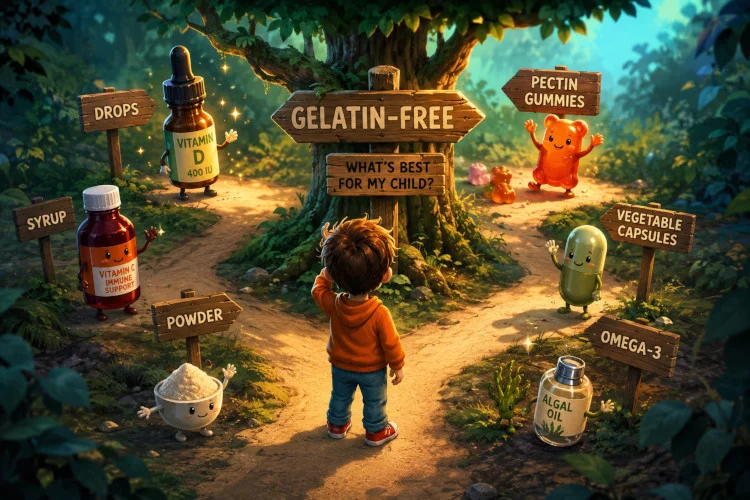
If a family avoids gelatin, it is better to start not with “which vitamin should I buy?”, but with “which form suits my child?”. One child calmly takes drops, another asks for syrup, a third accepts only gummies, and a school-age child may already be able to swallow a small capsule.
Simple drops, powders and some syrups usually do not contain gelatin, but this does not automatically make them better. Each form has its own details: carrier oil, sweeteners, taste, concentration, age-appropriate dosage and additional ingredients.
The main idea is simple: a gelatin-free form should be not only convenient, but also clear in composition.
🧩 Quick guide for parents
If gelatin is not suitable for a child, parents usually consider drops, syrups, powders, pectin gummies or capsules with a vegetable shell. But even with a gelatin-free label, it is still worth checking the full ingredients, age range, dosage and overlap with other supplements.
🗺️ What we will go through
- 🍬 Where gelatin is most often found in children’s supplements
- 💧 Which gelatin-free forms are convenient for children of different ages
- 🌱 How pectin gummies and vegetable capsules differ from gelatin forms
- 🔎 How to read the ingredients of gummies, softgels, drops and capsules
- 🩺 When it is better to discuss the supplement form with a doctor
🧭 How Bio Kids evaluates children’s supplement forms
At Bio Kids, we do not consider one supplement form to be universally best. Drops, syrup, powder, gummies and capsules can all be convenient in different situations. For parents, what matters more is not a trendy word on the package, but a clear formula, age-appropriate dosage and a form the child can actually take.
If a family avoids gelatin, that is a normal selection criterion. But it should not be the only one: even a gelatin-free supplement still requires checking the base, sweeteners, colorants, dosage and other active ingredients.
🍬 Where gelatin is most often found in children’s gummies and softgels
Gelatin is used because it holds shape well. It makes gummies springy, softgels elastic and chewable pastilles similar to jelly sweets. That is why parents most often find gelatin, gelatine, bovine gelatin or porcine gelatin in these types of supplements.
For some families, this is a dietary issue; for others, it is about religious rules; for others, it is a personal choice. Sometimes parents also avoid gelatin because gummies often contain acids, flavors, colorants and sweeteners along with it.
If basic daily support is needed without gelatin gummies and a complicated shell, you can look at gelatin-free vitamins for children, where the main criterion is a clear form and a formula without unnecessary overload.
How gelatin may be listed
On the label, it may appear as gelatin, gelatine, capsule shell, softgel, bovine gelatin or porcine gelatin. In product descriptions, it may also be written as “gelatin”, “gelatin capsule”, “soft capsule” or “capsule shell”.
If the translated ingredient list is shortened, it is better to check the original label. Sometimes gelatin is not highlighted on the front of the package, but it is present in the full ingredient list.
💧 Gelatin-free drops, syrups and powders: what is more convenient for a child
Drops are often chosen for young children because they are easier to dose. They can be given from a spoon or added to a small amount of food, if the instructions allow it. But with drops, you need to check the carrier oil, concentration and age range.
Syrups are convenient for children who do not like drops or powders. But syrups more often contain sweeteners, flavors, acids and preservatives. If you choose a syrup only because it does not contain gelatin, you may miss other important details.
Powders can be convenient when a form without a shell is needed. Sometimes they have a shorter formula, but not every child likes the taste or texture.
Gelatin-free vitamin drops for children are usually suitable when a small dosage is needed and the parent wants to avoid gummies. But even here it is important to look at the base: oil, glycerin, taste or other additional ingredients.
🌱 Pectin gummies and vegetable capsules are not the same as gelatin forms
Pectin is a plant-based alternative to gelatin. It is often used in gelatin-free gummies to help the pastille keep its shape. For families avoiding animal-derived ingredients, this can be a convenient option.
Pectin vitamins for children can be a good alternative to gelatin gummies, but they still need to be assessed by the full ingredient list. They may contain sugar, syrups, acids, flavors, fruit concentrates and colorants. Pectin solves the gelatin question, but it does not automatically make the formula simple.
Vegetable capsules are most often made from cellulose. On the label, you may see words such as vegetable capsule, cellulose, HPMC or hypromellose. This is a useful clue if you are looking for a gelatin-free capsule composition, but it is still worth checking the capsule size and the child’s age.
🐟 Gelatin-free omega-3: both the source and the shell matter
With omega-3, the gelatin question is especially noticeable. Regular soft capsules are often gelatin-based, and the omega-3 source is often fish oil. If a family avoids animal-derived ingredients, two things should be checked at once: where the omega-3 comes from and what the shell is made of.
For children who cannot take fish-based products or gelatin softgels, parents sometimes consider vegan omega 3 without gelatin for children. This form may fit dietary, religious or ethical reasons, but it is still important to check the carrier oil, flavor and age-appropriate dosage.
If omega-3 comes in liquid form, check the taste, smell, base and dosing method. If it is a capsule, check the shell. If it is a gummy, check pectin, acids, sweeteners and colorants.
🔎 How to read the ingredients of gummies, softgels, drops and capsules
Do not stop at the front of the package. Labels such as gelatin-free, vegan, plant-based and vegetarian are useful, but they do not replace the full ingredient list.
First, identify the form: drops, syrup, powder, gummies, capsules or softgels. Then look at the base or shell. If it is a capsule, check what it is made from. If it is a gummy, check what creates the texture: gelatin, pectin, starch or another base.
For drops and syrups, instead of the shell, look at the base: oil, glycerin, sweeteners, taste, concentration and preservatives. These details may be more important than the “gelatin-free” label itself.
Useful words on the label:
- gelatin-free;
- vegan;
- vegetarian;
- pectin;
- vegetable capsule;
- cellulose;
- HPMC;
- hypromellose.
These words help quickly filter out unsuitable options, but after that you still need to check dosage, age range and additional ingredients.
☀️ Gelatin-free vitamin D: which forms are more common
Vitamin D is often available as drops, sprays, powders, chewable forms and capsules. If the family avoids gelatin, it is easier to start with forms without a shell: drops, spray or powder.
In drops, it is important to check the carrier oil: sunflower, olive, coconut or another oil. Sprays may contain flavors and sweeteners. Powders may contain fillers and specific dosing details.
If you need gelatin-free vitamin D for children, parents should check not only the absence of gelatin, but also the age-appropriate dosage. Vitamin D should not be given in a high dose “just in case”, especially if the child already receives it from another supplement, formula or therapeutic nutrition.
📋 Table: which gelatin-free form may suit a child
| Supplement form | When it is convenient | What to check |
|---|---|---|
| Drops | For young children and precise dosing | Carrier oil, concentration, age |
| Syrup | If the child struggles with drops or powder | Sugar, taste, colorants, preservatives |
| Powder | If a form without a shell is needed | Taste, solubility, dosage |
| Pectin gummies | If the child likes chewable forms | Pectin, sugar, acids, colorants |
| Vegetable capsule | For children who can already swallow capsules | HPMC, cellulose, capsule size |
Gelatin-free vitamins for children in drops, syrups and plant-based forms
The Smurfs
Chewable multivitamins for children aged 3+, berry flavor
- Age: 3+
- Form: Chewable
- Flavor: Berry
You will be redirected to our partner’s website.
Trace
Liquid multivitamins for kids — tropical punch
- Age: From 1 to 3 years old
- Form: Liquids
- Flavor: tropical punch
You will be redirected to our partner’s website.
ChildLife Essentials
Sugar-free multivitamin gummy chews, Natural strawberry and lemon
- Age: From 4 years old
- Form: Chewable
- Flavor: Natural strawberry and lemon
You will be redirected to our partner’s website.
🍊 Gelatin-free vitamin C: why a chewable form is not always simpler
Vitamin C for children is often made as pastilles, powders, syrups, chewable tablets and gummies. Because of the sour taste, sweeteners, flavors, fruit concentrates and acids may be added.
If a parent is looking for gelatin-free vitamin C for children, it is important to check not only the absence of gelatin, but also the form. Powder may be simpler in composition, but not always convenient for the child. Syrup may taste better, but often contains more additional ingredients. A pectin gummy may be gelatin-free, but still sweet and acidic.
🧪 How not to replace one problem with another
A gelatin-free supplement does not automatically become suitable. The formula may contain sugar syrups, colorants, acids, flavors, herbs or several vitamins in high dosages.
Special caution is needed with “all-in-one” complexes. If a child only needs vitamin D or vitamin C, a large formula may create unnecessary overlap with other supplements.
It is better to introduce one new product at a time. This makes it easier to understand tolerance and avoid overloading the child’s diet.
📸 What to save from the label before buying
Before buying, it is useful to save:
- the full ingredient list;
- other ingredients;
- the supplement form;
- the capsule shell composition;
- the age range and dosage;
- the source of the vitamin or omega-3;
- allergen warnings;
- vegan, vegetarian, gelatin-free labels.
This helps compare several options calmly and, if needed, show the composition to a doctor.
🩺 When it is better to discuss the supplement form with a doctor
Consultation is especially important if a child has allergies, chronic conditions, gastrointestinal issues, metabolic disorders or already takes medicines and supplements.
Separate caution is needed with vitamin D, vitamin A, iodine, iron and high dosages. Even if the product is gelatin-free, this does not mean it can be given without a clear reason.
A doctor can also help if a child does not tolerate many forms: refuses syrups, cannot swallow capsules, rejects powders or reacts to chewable pastilles.
❓ Common questions about gelatin-free vitamins for children

Gelatin helps make the gummy elastic and similar to jelly candy. That is why it is often used in gummies and soft capsules. If a family avoids gelatin, the full ingredient list should be checked, especially the shell and the base of the form.
Pectin gummies are suitable for those who avoid gelatin because pectin is plant-based. But they may still contain sugar, acids, flavors, colorants and sweeteners.
Most often, drops or syrups are convenient for young children if they match the age and dosage. But the base, taste, concentration and additional ingredients still need to be checked.
Look for the capsule shell composition. Suitable words include vegetable capsule, cellulose, HPMC, hypromellose. If it only says capsule shell without details, it is better to check the full label.
No. Vegan usually means there are no animal-derived ingredients, but it does not evaluate dosage, age range, sweeteners, colorants and other substances. For a child, the whole formula matters.
Not necessarily. It may suit the family better for dietary, religious or ethical reasons, but safety depends on dosage, age, ingredients, allergens and other supplements the child receives.
✅ Gelatin-free vitamins for children: how to choose more calmly
This article is useful for parents who avoid gelatin in children’s supplements and want to understand which forms may suit their child. The reasons may be different: diet, religious restrictions, a vegetarian approach, allergies or the desire to choose a simpler form.
First, it is worth choosing a convenient format: drops, syrup, powder, pectin gummy or vegetable capsule. Then read the full ingredient list and check the shell, base, taste, sweeteners, age range and dosage.
A supplement may be appropriate if it has a clear form, a transparent composition and no unnecessary overlap with other products. But if a child has chronic conditions, pronounced reactions or needs a high dosage, it is better not to choose on your own.
⚠️ What to remember about gelatin-free supplements
This article helps parents understand the forms of gelatin-free children’s supplements: drops, syrups, powders, gummies and capsules. The material is informational and is not a medical prescription.
If a child has allergies, chronic conditions, unusual reactions to products or already takes medicines and other supplements, it is better to discuss the choice with a pediatrician. Bio Kids publishes independent materials about children’s supplements and helps parents read ingredients more carefully, but it does not replace a doctor’s consultation.