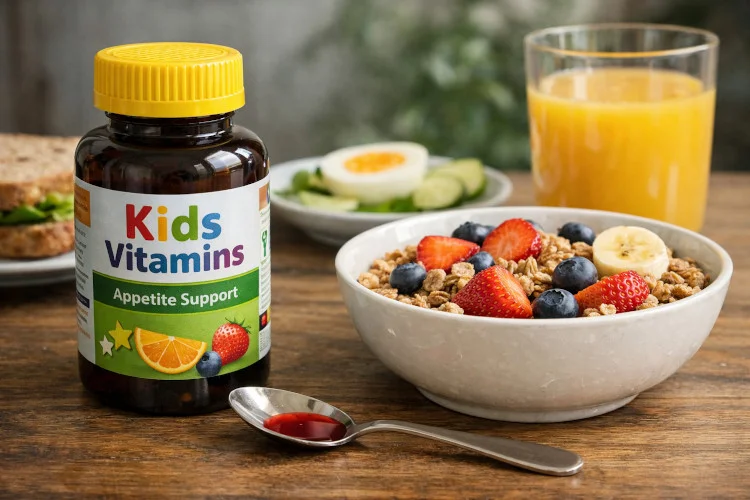

At 8 years old, a school day can already feel like a small marathon: waking up early, sitting through lessons, doing homework, going to an activity, and still not feeling completely worn out by evening. Parents often notice small signs quickly: the child does not want breakfast, asks for something sweet after school, gets distracted during homework, and by evening tiredness turns into irritability.
At that moment, it is easy to think: maybe they need vitamins. But first, it is more useful to understand what exactly seems to be missing — nutrition, focus, energy, support during cold season, or overall dietary balance.
✅ Before choosing vitamins for an 8-year-old child, it is important to remember
Supplements can be part of support, but they do not replace the basics: regular meals, rest, water, movement, and an age-appropriate workload. It is better to choose not “the strongest complex,” but support for a specific need: omega-3 — if the child rarely eats fish, vitamin C or fiber — if the diet is low in fresh foods, vitamin C with zinc — as a seasonal option.
If tiredness is pronounced or appeared suddenly, it is better to understand the reason first, rather than starting several supplements at once.
📌 Article navigation
- 🧠 Vitamins for an 8-year-old child for learning and concentration
- ⚡ Vitamins for energy in an 8-year-old child during school workload
- 🐟 Omega-3 for concentration in 8-year-old children if they rarely eat fish
- 🍊 Vitamin C for an 8-year-old child if they eat few fruits and vegetables
- 🛡️ Vitamin C with zinc for 8-year-old children during cold season
- 🌾 Fiber for school-age children if they eat few vegetables
- ⚖️ How to choose vitamins for an 8-year-old child by ingredients and dosage
- ❌ Mistakes parents make when choosing vitamins for a school-age child
🧭 How We Approach Choosing Supplements for Children
In this article, we look at supplements not as a universal solution, but as part of overall support: nutrition, age, school workload, form of intake, dosages, and overlap with other complexes. This approach helps parents choose not “the most complete bottle,” but what fits the child’s actual situation.
🧠 Vitamins for an 8-year-old child for learning and concentration
When a child sits with their homework, reads the task three times, and still gets distracted by a pencil, the window, or a toy, parents often start thinking about vitamins “for the brain.” That reaction is understandable: you want to support your child so school feels easier.
But concentration at 8 years old does not depend only on supplements. Attention is influenced by after-school tiredness, anxiety, screen time, the number of extracurricular activities, and even how well the child understood the lesson.
If a child goes to bed late, barely eats in the morning, and does homework in the evening after a class or sports practice, calm concentration is hard to expect. In that situation, a supplement may be only a small part of support, not the main solution.
For attention, parents often discuss omega-3, B vitamins in children’s complexes, magnesium in age-appropriate dosages, and overall dietary balance. But the choice should be based not on promises like “for excellent school performance,” but on a specific reason: for example, the child rarely eats fish, skips breakfast, or has a very monotonous diet.
Vitamins for learning in an 8-year-old child should be considered together with daily routine, normal nutrition, and a reasonable school workload.
⚡ Vitamins for energy in an 8-year-old child during school workload
Tiredness after school can look different. One child comes home and immediately lies down on the sofa. Another becomes irritable, argues about homework, and asks for sweets. A third manages through the whole day, but by evening becomes disorganized and cannot even pack their school bag.
In such situations, parents often look for vitamins for energy in an 8-year-old child. Before buying anything, it is worth looking at simple things: how the child eats breakfast, whether there is enough protein in the diet, whether they drink water, and whether they have a break between school and homework.
If the diet is monotonous, the child avoids certain food groups, or the workload has temporarily increased, an energy and activity complex may be appropriate. But it should match the child’s age and not duplicate what the child is already taking.
Vitamins for energy in an 8-year-old child should not contain very high dosages “just in case.” Extra caution is needed with iron, iodine, vitamin A, and high doses of vitamin D.
🐟 Omega-3 for concentration in 8-year-old children if they rarely eat fish
Omega-3 is often discussed when a child struggles to maintain attention, gets tired quickly while reading, or almost never eats fish. For a school-age child, it is one of the most common options for supporting the diet.
If a child regularly eats fish, eggs, nuts, seeds, and generally has a varied diet, a separate supplement may not be obviously necessary. But if fish is almost absent and the diet often relies on pasta, bread, yogurts, and sweet snacks, the omega-3 question becomes more relevant.
When parents choose omega-3 for concentration in 8-year-old children, it is important to look not only at the dose, but also at the form. One child may prefer a chewable capsule, another a liquid form, while a third may not tolerate a fishy taste.
Omega-3 is better seen as part of the diet, not as a quick way to change behavior during homework. It is one support option when the diet contains few sources of beneficial fatty acids.
🍊 Vitamin C for an 8-year-old child if they eat few fruits and vegetables
Parents often remember vitamin C in autumn and winter, but it is better to start not with a supplement, but with the diet. This vitamin is found in everyday foods: citrus fruits, kiwi, berries, sweet peppers, cabbage, potatoes, and greens. If a child eats vegetables and fruits every day, a separate supplement may not be needed on a regular basis.
Another situation is when a school-age child almost does not eat fresh foods, refuses vegetables, and mainly chooses pasta, bread, cheese snacks, yogurts, and sweets. Then vitamin C for an 8-year-old schoolchild may be considered as temporary dietary support, especially during periods of school workload.
It is important not to choose high doses “to be safe” and not to give several products with vitamin C at the same time. Vitamin C may already be included in a multivitamin, chewables, syrup, or a seasonal complex.
Vitamin C for an 8-year-old child is not a guarantee that the child will not get sick. It is one of the nutrients that should be present in the diet in an appropriate amount.
🛡️ Vitamin C with zinc for 8-year-old children during cold season
The combination of vitamin C and zinc is mostly related to seasonal support. It is usually considered when a child goes to school, clubs, sports activities, and has more frequent contact with other children.
Zinc is an important nutrient, but moderation matters here. If a child already takes a multivitamin or an “immune support” complex, zinc may be repeated in the formula.
When choosing vitamin C with zinc for 8-year-old children, check the age recommendation, the dosage of vitamin C and zinc, the intended duration of use, and overlap with other supplements. It is also worth considering the child’s sensitivity to sour tastes, sweeteners, and flavorings.
This type of support should not be given constantly without a clear reason. It may be appropriate during a demanding season, but it is important not to duplicate zinc and vitamin C with other complexes.
🌾 Fiber for school-age children if they eat few vegetables
By the age of 8, children may already have established eating habits. One child does not eat vegetables “in any form.” Another chooses only pasta, bread, cheese, and sweets. A third barely eats at school, but asks for a bun or cookies in the evening.
In such situations, parents sometimes think about fiber for school-age children. Fiber really is important for the diet, but it is better to start with regular food: vegetables, fruits, berries, whole grains, and legumes, if the child tolerates them.
A fiber supplement may be an option if the diet is low in plant foods. But it should be introduced gradually and with attention to water intake. A sudden increase in fiber may cause bloating, abdominal discomfort, or make the child refuse to continue taking it.
Fiber for school-age children is not a case of “the more, the better.” Gradual introduction, enough water, and good tolerance matter here.
⚖️ How to choose vitamins for an 8-year-old child by ingredients and dosage
Before buying, it is useful not to start with the question “which vitamins are the strongest?” A better starting point is: what does the child need right now?
| What parents notice | What to check first | What support may be considered carefully |
|---|---|---|
| Gets tired after school and asks for sweets | Breakfast, protein, water, too many activities | Age-appropriate energy complex, without extra iron or iodine |
| Struggles to stay focused on homework | Breaks, screen time, clarity of the task | Omega-3, if there is little fish in the diet |
| Almost does not eat fruits and vegetables | Diet, snacks, simple ways to serve food | Vitamin C or fiber, without sudden introduction |
| Has frequent contact with children during cold season | Nutrition, walks, hand hygiene, routine | Vitamin C with zinc, if there is no duplication |
| Already takes a multivitamin | Full ingredient list of all supplements | Do not add similar components “just to be safe” |
After looking at it this way, it usually becomes clearer: the child may not need “one bottle for everything,” but more precise support — or first, an adjustment of routine.
Before buying, it is worth looking not only at the product name, but also at the label: recommended age, serving size, daily dosages, sweeteners, allergens, and repeated ingredients. For an 8-year-old child, the form of the supplement also matters: a large capsule may not work, overly sour chewables may quickly become unpleasant, and a syrup with a strong flavor will not suit every child. That is why a good choice is not only about ingredients, but also about how the child will actually take the supplement without daily arguments.
Vitamins for an 8-year-old child for school, energy, and activity
Culturelle
For children: probiotics, immune defense, super berries
- Age: from 3 to 12 years old
- Form: Chewable
- Flavor: Berry
You will be redirected to our partner’s website.
Kidz
Daily chewable supplement for immune support
- Age: from 4 to 13 years old
- Form: Chewable
- Flavor: fruit
You will be redirected to our partner’s website.
California Gold Nutrition
Multivitamins and minerals with calcium, vitamins B12, C, and D3
- Age: from 4+ years old
- Form: Liquids
- Flavor: orange and mango
You will be redirected to our partner’s website.
❌ Mistakes parents make when choosing vitamins for a school-age child
The most common mistake is choosing the biggest complex “for everything.” It may seem that the longer the ingredient list, the better the product. But for a child, that is not always true: a long formula increases the risk of duplication and unnecessary dosages.
The second mistake is giving several supplements at the same time. For example: a multivitamin, vitamin C, zinc, omega-3, an “immune support” syrup, and something else “for energy.” In the end, it becomes difficult to understand what is truly needed and what is simply being repeated.
The third mistake is ignoring the form. An 8-year-old may refuse a large capsule, an overly sour chewable tablet, or a syrup with a strong taste. Then the supplement stops being support and becomes a daily argument.
How not to overload a child with supplements:
- do not start several new products at once;
- check the ingredients of vitamins already purchased;
- do not duplicate vitamin C, zinc, vitamin D, and iodine;
- choose an age-appropriate dosage;
- do not use adult complexes;
- if symptoms are pronounced, first try to understand the cause rather than adding new complexes.
Another mistake is expecting a quick change in behavior. If a child is overloaded, sleeps too little, and feels tense because of school, vitamins do not replace rest, a calmer routine, and a normal homework break.
🩺 When It Is Better to See a Doctor Rather Than Choose Vitamins for an 8-Year-Old Child Yourself
Sometimes a schoolchild’s tiredness is not just “too much homework” or “autumn.” It is better to see a doctor if the child is constantly low on energy, pale, complains of dizziness, gets tired quickly during normal activities, suddenly loses appetite, or starts sleeping worse.
A consultation is also important if there are frequent abdominal pains, long-term bowel issues, headaches, frequent illnesses, noticeable weight loss, strong anxiety, or sudden changes in behavior.
Special caution is needed with iron, iodine, vitamin A, and high doses of vitamin D. These supplements are better chosen not based on internet advice, but after assessing the child’s condition and following a specialist’s recommendations.
❓ Frequently Asked Questions About Vitamins for an 8-Year-Old Child for School and Energy

First, it is worth offering not a capsule, but a break. After school, a child often needs to eat, drink water, change clothes, rest a little, and switch gears. If they are immediately put in front of homework, tiredness may look like laziness, moodiness, or “I don’t understand anything.”
Among supplements, age-appropriate energy and activity complexes may be considered, especially if the diet is monotonous or the child is a picky eater. But if tiredness is constant, there is paleness, dizziness, weakness, or the child suddenly becomes much less active, this is no longer a situation for choosing vitamins “at random.”
There is no single “vitamin for attention.” Concentration is not only about memory, but also emotional load, clarity of school material, tiredness after lessons, and how the child’s day is organized.
Parents often consider omega-3, age-appropriate children’s complexes, and dietary support if nutrition is monotonous. But the choice should be based not on the idea of “for the brain,” but on the real situation: little fish, a weak breakfast, too much screen time, high workload, or lack of proper breaks.
If a child almost does not eat fish, omega-3 can indeed be worth discussing. It is not a tool for instant concentration, but a way to support a diet that contains few sources of beneficial fatty acids.
Age, dosage, form, and taste matter when choosing. If the supplement is unpleasant for the child, it will quickly become a source of conflict, so sometimes a convenient form is more important than the “ideal” formula on paper.
Yes, if the supplement is age-appropriate, the dosage is not excessive, and there is a clear reason for taking it. But if the child normally eats fruits, berries, vegetables, and greens, a separate daily vitamin C supplement may not be necessary.
It is important to remember that vitamin C is often already present in multivitamins, chewables, seasonal complexes, and drinks. Parents may not notice that they are giving the same component from several sources. That is why before daily use, it is worth checking all supplements already at home.
Not always. Vitamin C and zinc are often already included in children’s multivitamins. If a separate “immune support” complex is added on top, duplication can happen easily.
Before combining products, compare the labels: how much vitamin C they contain, how much zinc, what serving size is recommended, and what age the product is intended for. Extra attention is needed if the child is taking a multivitamin, chewables, syrup, and separate zinc at the same time.
If a child almost does not eat vegetables, fiber may be worth discussing, but it is better to start not with powders or chewable tablets, but with food. Simple steps sometimes help: berries in porridge, fruit as a snack, vegetables in cream soup, whole-grain bread, cereals, and homemade sauces with vegetables.
A fiber supplement may be useful if the diet is truly low in plant foods. But it should be introduced gradually and with attention to water intake. If there is abdominal pain, constipation, diarrhea, or pronounced discomfort, fiber should not be chosen at random.
✅ How to Choose Vitamins for an 8-Year-Old Child for School and Energy Without Unnecessary Risk
Good support for a school-age child does not start with the biggest bottle, but with careful observation. When does the child get tired? What do they eat in the morning? Are there fish, vegetables, fruits, and normal snacks? When is it harder for them to concentrate — after school, after activities, after screens, or after going to bed late?
When the picture becomes clearer, it is easier to choose a supplement calmly: omega-3 — if the child rarely eats fish, vitamin C — if the diet contains very few fresh foods, fiber — if there are few plant foods, vitamin C with zinc — as seasonal support without duplication. This approach helps avoid collecting unnecessary bottles and expecting from vitamins what should come from nutrition, rest, and a normal daily rhythm.
Disclaimer: This material is for informational purposes only and is not a medical recommendation. Bio Kids publishes independent informational materials about children’s supplements, but it does not replace a doctor’s consultation, diagnosis, or individual recommendations from a specialist.