
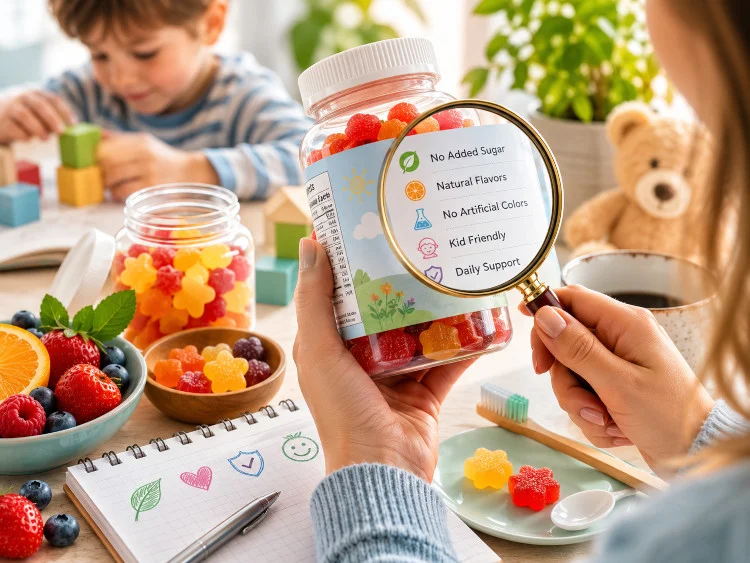
Many parents start looking for sugar free vitamins for kids when they want to reduce extra sugar in their child’s daily routine. This becomes especially important when children take chewable vitamins that taste almost exactly like regular candy.
Your child comes home tired after school, barely touches dinner, but happily asks for a sweet gummy vitamin. For parents, this feels convenient: no persuading, no swallowing capsules, and the taste is pleasant. But this is exactly where syrups, acids, sweeteners, flavoring agents, and artificial colors often appear.
That is why choosing sugar-free vitamins should never depend only on the label saying sugar-free. It is important to understand what replaced the sugar, whether the formula works for daily use, whether the gummy sticks to teeth, and whether the dosage overlaps with other supplements your child already takes.
What Parents Should Check First
Sugar-free does not automatically mean a clean formula. Sugar may be absent, but manufacturers often replace it with sweeteners, acids, and flavoring agents.
Sugar-free chewable vitamins can be practical when children dislike swallowing capsules, but they should never be treated like candy.
For dental health, it is not only sugar that matters. Acidic taste, sticky texture, and taking gummies before bedtime can also affect teeth.
Parents should always check age recommendations, dosage, allergens, vitamin D, vitamin A, iodine, iron, and overlap with other supplement formulas.
If your child has unusual fatigue, poor appetite, pale skin, stomach discomfort, or chronic health issues, choosing supplements is something worth discussing with a doctor first.
Quick Guide Before Buying
Sugar-free vitamins can be useful when parents want to reduce unnecessary sugar intake. But the full ingredient label matters far more than a simple “sugar-free” claim. The form, sweeteners, acidity, flavoring agents, age recommendation, and dosage all matter.
What To Understand Before Choosing Sugar-Free Vitamins
- 🍬 Why sugar-free chewable vitamins for kids still taste sweet
- 🏷️ How to read sugar-free vitamin labels for children
- 🦷 Which sugar-free vitamins are better for sensitive teeth
- 🐟 Which children’s supplements without sugar contain more sweeteners
- 🧒 Sugar-free vitamins for picky eaters: when the form helps and when it does not
🧭 How Bio Kids Evaluates Children’s Supplements
At Bio Kids, we look at children’s supplements as possible nutritional support, never as a replacement for balanced meals, sleep, outdoor activity, or medical advice. Parents should focus on understanding labels rather than trusting marketing promises.
If a supplement is taken daily, ingredients become especially important. What children consume every day should not look or behave like candy with a long list of flavor additives.
🍬 Why sugar-free chewable vitamins for kids still taste sweet
Children’s formulas rarely taste neutral. Vitamin C naturally tastes sour, omega-3 often has a fishy taste, and some minerals can leave a bitter or metallic aftertaste. To make products easier for children to accept, manufacturers use gummies, chewables, syrups, flavored drops, and other pleasant-tasting forms.
Traditional chewable vitamins usually rely on sugar, glucose syrup, fructose, or sweet syrups for taste. Sugar-free versions replace those ingredients with sweeteners such as xylitol, sorbitol, erythritol, stevia, or other alternatives.
Why Sugar-Free Gummies for Kids Often Feel Like Candy
A gummy has to keep its shape, taste pleasant, and be easy to chew. That usually means adding pectin, gelling agents, acids, fruit flavors, sweeteners, and coloring ingredients.
This is not automatically a problem, but parents should understand that sugar free gummy vitamins for kids can still create the habit of associating vitamins with sweets. If a child asks for another gummy simply because it tastes good, it helps to set one clear rule: vitamins are taken only according to the serving size.
🏷️ How to read sugar-free vitamin labels for children
The word sugar-free only means traditional sugar or added sugar is absent. It does not guarantee a simple or minimal ingredient list. Parents should always check the supplement facts panel and full ingredient list instead of only reading the front label.
When choosing daily nutritional support, parents often look for daily sugar free vitamins for kids with clear dosage, age-appropriate formulas, and no unnecessary sweet base.
What To Check First On The Label
Always check the recommended age first. A formula designed for toddlers is completely different from one intended for school-age children. Then check serving size, because some products calculate dosage based on two gummies while children may only take one.
After that, review the ingredient base. If sweeteners, acids, flavors, and artificial colors appear at the top of the list, the product may taste good but may not be ideal for long-term daily use.
Focus on these basics:
- age recommendation and serving size
- sweeteners, acids, and flavoring agents
- allergens;
- overlap with other supplements already being used
Which Sweeteners Are Most Common In Sugar-Free Kids Vitamins
Sugar-free products often use sugar alcohols like xylitol, sorbitol, and erythritol. In some children, these ingredients may cause bloating, digestive discomfort, or loose stools, especially if they also consume other sugar-free products.
Stevia and sucralose are also commonly used for sweetness. These ingredients do not automatically make the formula bad, but parents should always judge the entire formula rather than focusing on a single ingredient.
Sugar free vitamins for children should never be given above recommended serving sizes. These are products containing active nutrients, not snacks that children can consume freely.
🦷 Which sugar-free vitamins are better for sensitive teeth
When it comes to dental health, sugar is not the only factor. If a gummy is acidic, sticky, and stays in the mouth for a long time, tooth enamel still experiences prolonged contact with acids and flavoring compounds. This matters even more when vitamins are taken before bed.
Many parents specifically search for sugar free vitamins for kids teeth, but the better approach is to look at the whole formula: lower acidity, less sticky texture, and avoiding habits where children suck on gummies like candy.
Chewable vitamins are generally better taken after meals rather than before sleep. If your child already has cavities, enamel sensitivity, or frequent dental visits, the supplement form deserves extra attention.
| Common Parent Concern | What To Check | How To Decide |
|---|---|---|
| Can sugar-free gummies be taken daily? | Sweeteners, acids, dosage | Follow age guidelines and avoid stacking supplements |
| Why does sugar-free vitamin still taste sweet? | Xylitol, sorbitol, stevia, flavoring | Evaluate the full ingredient list |
| Child chews gummies for a long time | Acids and sticky gummy texture | Give after meals instead of bedtime |
| Child has a sensitive stomach | Sugar alcohols | Stay within dosage and monitor reactions |
| How to avoid excessive dosage overlap | Vitamin D, A, iodine, iron | Compare all products already being used |
Sugar free chewable vitamins for kids with simple ingredients
GreenPeach
Calcium, magnesium and zinc, orange
- Age: from 1 to 12+ years old
- Form: Liquids
- Flavor: orange
You will be redirected to our partner’s website.
Mel-O-Licious!
Chewable gummies, natural cherry and orange.
- Age: From 4 years old
- Form: Chewable
- Flavor: cherry and orange
You will be redirected to our partner’s website.
You will be redirected to our partner’s website.
🐟 Which children’s supplements without sugar contain more sweeteners
Different supplements have different taste challenges. Because of this, the idea of sugar-free looks very different depending on the product type.
Vitamin C naturally tastes sour. If parents are comparing options, it helps to look at sugar free vitamin C for kids based not on flavor but on dosage, acidity level, sweeteners, and age recommendations.
Omega-3 products are more difficult because of their fish taste. To mask this, manufacturers often add lemon, orange, berry, vanilla, or other flavoring agents. When children dislike fish taste, parents often search for omega 3 without fishy taste for kids, but here it is equally important to check oil source, EPA/DHA levels, and allergens.
Multivitamins require separate attention. A single formula may contain vitamin D, vitamin A, iodine, zinc, iron, and many other nutrients. If children already take separate vitamin D or fortified omega-3, ingredient overlap becomes possible.
Where Sugar Ingredients Commonly Appear In Kids Supplements
Sweet ingredient bases most often appear in gummies, chewables, syrups, sour vitamin products, and flavored liquid supplements.
Parents should look beyond the word sugar itself. Sugar ingredients may also appear as glucose syrup, fructose, cane sugar, maltodextrin, or other syrup-based compounds.
If the goal is choosing sugar free vitamins for kids, do not focus on one supplement form only. Drops, powders, or capsules sometimes have much simpler ingredient lists, although not every child accepts those forms.
🧒 Sugar-free vitamins for picky eaters: when the form helps and when it does not
For picky eaters, the problem usually starts at the dinner table. The child avoids fish, refuses vegetables, barely eats breakfast, but asks for sweet snacks after school. Parents want nutritional support without creating another habit centered around sweet flavors.
If your child eats selectively and seems tired often, sugar free vitamins for picky eaters may sometimes be a better option than sweet gummy formulas, but they should never replace normal meals or work around food habits.
When Sugar-Free Chewable Vitamins Actually Help
Chewable forms may help when children dislike swallowing capsules, reject liquid drops, or refuse powders because of taste. But the supplement form should make administration easier, not turn vitamins into a daily dessert.
For picky eaters, parents should avoid choosing products simply because they contain more nutrients, avoid using gummies as rewards, and pay extra attention to iron, iodine, vitamin A, and vitamin D.
🩺 When It Is Better to See a Doctor Instead of Choosing Supplements Yourself
Parents should avoid choosing supplements independently when children show unusual fatigue, pale skin, sudden appetite loss, weight loss, repeated stomach pain, long-term digestive problems, or recurring physical complaints.
Medical advice becomes especially important when children take prescription medication, have chronic health conditions, allergies, dietary restrictions, or already use several supplement products at the same time.
Iron, iodine, vitamin D, and vitamin A require special caution. These nutrients should never be used casually in high doses. Plant extracts also should not be treated as automatically safe simply because they are natural.
❓ Common Questions About Sugar-Free Vitamins For Kids

For daily use, choose a product with clear dosage instructions, age-appropriate formulation, and minimal unnecessary acids, flavors, and artificial colors. Always check for overlap with other supplements already being used.
Not necessarily, but the form matters. Acidic sticky gummies that stay in the mouth for a long time may affect enamel more than expected. Taking them after meals is usually safer.
No. Sugar-free usually only means traditional sugar is absent. Products may still contain xylitol, sorbitol, erythritol, stevia, sucralose, or similar alternatives.
Long-term daily use should not become an automatic habit without understanding the reason. Even sugar-free products contain active nutrients that require correct dosage.
It depends on the child and the formula. Gummies are convenient but often contain more acids and flavoring agents. Liquid drops may have simpler formulas but are not accepted by every child.
Sometimes yes, but supplements do not solve the reason behind selective eating habits. If children eat poorly, lose weight, or seem constantly tired, medical evaluation should come first.
✅ How To Choose Good Sugar-Free Vitamins For Kids Without Making Mistakes
This guide helps parents who want to reduce sugar exposure while comparing children’s supplements more carefully. If the goal is choosing chewable sugar-free vitamins, the first thing to examine is the label: dosage, age recommendation, sweeteners, acids, flavoring agents, coloring ingredients, allergens, and possible overlap with other products.
A sugar-free formula may make sense when a child needs specific nutritional support and traditional sweet gummy vitamins are not the best option. But persistent symptoms, chronic conditions, allergies, or dosage concerns should never be handled without professional advice.
⚠️ What Parents Should Remember Before Choosing Children’s Supplements
This material is for informational purposes only and should not be treated as medical advice. Children’s supplements do not replace balanced nutrition, healthy sleep, outdoor activity, medical treatment, or professional consultation.
Bio Kids publishes independent educational materials about children’s supplements, ingredients, formula quality, and safe supplement selection, but never replaces advice from a pediatrician or qualified healthcare professional.